Rigid fiberglass insulation panels offer a balance of fire resistance, sound absorption, and thermal performance for ducts, walls, and ceilings. This guide highlights top options that consistently perform well in real-world applications, with a focus on NRC ratings, thickness, and durability. Each product profile includes practical uses and key strengths to help you choose the right panel for your project.
| Product | Brand | Size / Thickness | Key Benefit |
|---|---|---|---|
| Owens Corning 703 Semi Rigid Board | Owens Corning | 24″ x 48″ x 2″ | High NRC (1.0) for strong sound absorption and solid thermal performance |
| ATS Acoustics Rigid Fiberglass Board | ATS Acoustics | 24″ x 48″ x 2″ | Close substitute for OC 703 with similar density and acoustical properties |
| F&L Johns Manville Duct Insulation Panel | F and L Aluminum Parts | 24″ x 48″ x 1.5″ | High R-value for ducts; durable with moisture-resistant facing |
| Owens Corning 703 FRK Semi Rigid Board | Owens Corning | 24″ x 48″ x 2″ | FRK facing reflects mid/high frequencies while absorbing lows |
| Roxul Rockboard 60 | Roxul | 24″ x 48″ x 2″ | Rigid mineral wool with NRC 1.0 and Class A fire rating |
Rigid fiberglass panels are widely used in HVAC, walls, ceilings, and studios due to their consistent density, moisture resistance, and ease of installation. The following sections review five top picks, drawing on common performance metrics such as NRC, R-values, density, and facing options to help you decide which panel best fits your project needs.
Owens Corning 703 Semi Rigid Board

These 2-inch boards come in a 6-pack of 24″ x 48″ panels. They deliver a Heat Resistance R-Value around 8.7, helping reduce heat transfer and operating costs. The board also has a Noise Reduction Coefficient (NRC) of 1.0, making them a strong option for rooms requiring effective sound absorption in addition to thermal management. This panel is a common choice for studios, home theaters, and duct transitions where vibration and echo reduction are important but space is limited. The unfaced surface supports clean, moisture-check installations in controlled environments.
ATS Acoustics Rigid Fiberglass Board

ATS Acoustics offers a 2-inch rigid fiberglass board packaged as a case of six 24″ x 48″ panels. The material is widely regarded as a close substitute for Owens Corning 703, sharing similar density and acoustical properties. It provides reliable sound absorption while maintaining solid moisture resistance and durability in duct or wall assemblies. This option is well-suited for professionals seeking a dependable alternative with comparable performance metrics.
F&L Johns Manville Duct Insulation Panel
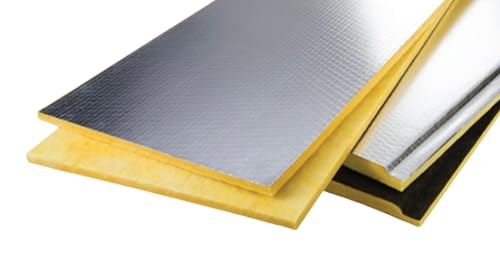
This 1.5-inch panel delivers high thermal performance with an approximate R-value of 6.5, making it effective for reducing heat loss in duct systems. The 3 lb density ensures durability and support for rigid installations. A Foil Scrim Kraft (FSK) facing increases moisture resistance and code compliance. This panel is designed for HVAC duct applications where both heat control and moisture resistance are critical.
Owens Corning 703 FRK Semi Rigid Board

The FRK variant features a Foil Reinforced Kraft facing. This aluminum-foil jacket with fiberglass reinforcement over rigid kraft paper offers easier cleaning and surface protection while reflecting some mid to high-range frequencies. The low-end frequencies pass through to the absorption material, balancing sound control and durability. This panel is suitable for installations requiring a protective facing with favorable acoustical properties.
F&L Fiberglass Board Acoustic Panels
These panels are designed for multi-layer thermal protection and acoustic performance. They are available in 1″, 1.5″, or 2″ thicknesses and come in 24″ x 24″ or 24″ x 48″ formats. The boards help maintain consistent indoor temperatures by reducing heat transfer, while absorbing mid- to high-frequency sounds. Flexible sizing supports various installations across walls, ceilings, studios, and HVAC ductwork.
Roxul Rockboard 60

Roxul Rockboard 60 is a mineral wool board with 6 lb density per cubic foot and a Class A fire rating per ASTM E84. It offers a robust NRC of 1.0, excellent fire resistance, and strong moisture resistance. This rigid insulation is well-suited for environments requiring high fire safety standards and reliable acoustic performance, including studios, mechanical rooms, and exterior sheathing where condensation risk exists.
Buying Guide: Key Purchase Considerations
Audience: Homeowners, contractors, and designers seek panels that balance acoustic performance, thermal efficiency, and ease of installation. Consider the intended use—studio spaces may prioritize higher NRC and density, while ductwork emphasizes moisture resistance and physical durability.
- Acoustic performance: Look for NRC ratings around 0.7–1.0 for general spaces; higher NRC is beneficial for rooms with echo issues or strict sound control needs.
- Thermal value: R-values roughly correlate with thickness and density. Choose panels with higher R-values when reducing heating and cooling loads is a priority.
- Facing and moisture: Foil or kraft faces improve moisture resistance and code compliance in some installations. Unfaced panels maximize absorption in controlled environments.
- Density and rigidity: Denser boards (e.g., 3 lb or higher) provide greater support for rigid installations and better sound blockage, but may be heavier and harder to cut.
- Size and thickness: Standard panels come in 24″ x 48″ with 1.5–2″ thickness for ducts and walls. Choose sizes that minimize seams and fit existing structures.
- Fire safety: Mineral wool options typically offer Class A fire ratings; fiberglass variants like OC 703 FRK add a protective facing while preserving acoustical properties.
- Installation practicality: Consider accessibility, mounting method, and compatibility with existing framing or duct systems. Unfaced boards ease bonding for customized applications.
For most American projects, selecting a mix of high-NRC boards for studios or living spaces and robust duct panels with moisture-resistant facings for HVAC runs provides balanced performance. When in doubt, standardize on a well-supported option like Owens Corning 703 family or Roxul Rockboard for consistent acoustics across environments. Always verify compatibility with local building codes and installation guidelines.