In HVAC and outdoor performance testing, choosing a reliable air velocity meter is essential. The following handheld anemometers offer precise wind speed, temperature, and CFM measurements, with features suited for duct work, field shooting, and drone operations. This guide highlights five top options to help professionals select the right instrument for their needs.
| Product | Brand | Key Features |
|---|---|---|
| Testo 405i | Testo | Hinged shaft up to 15″ for hard-to-reach spots; measures air velocity, in-duct airflow, temperature; Bluetooth/app capable |
| AP-856A Pro HVAC Anemometer | AOPUTTRIVER | USB data export; MAX/AVG/MIN; 5 units; CFM meter; stretchable blades |
| AP-846A HVAC Anemometer | AOPUTTRIVER | High-precision wind speed; CFM/CMM; backlit display; MAX/MIN/AVG |
| HoldPeak 866B | H HOLDPEAK | Bluetooth remote monitoring; app connectivity; multi-parameter display; backlit |
| Bonvoisin Hotwire Anemometer | Bonvoisin | Measures velocity, airflow (CFM/CMM), temperature; backlight; 2m probe; auto-off |
Note: All measurements are subject to device calibration and operating conditions. The listed features reflect each model’s capabilities, and not every feature may be necessary for every task. This selection emphasizes versatility, data logging options, and ease of use in HVAC, outdoor testing, or aerial applications.
Testo 405i – Anemometer with Bluetooth

The Testo 405i handheld anemometer measures air velocity, temperature, and in-duct airflow. It can calculate volume flow when duct dimensions are provided, making it applicable for HVAC servicing and installation. Its telescopic shaft extends up to 15 inches, enabling access to tight spaces. The device is compact and portable, designed for both fieldwork and professional use, supporting practical, on-site measurements with a reliable hinge design for flexible measurement angles.
AP-856A Pro HVAC Anemometer
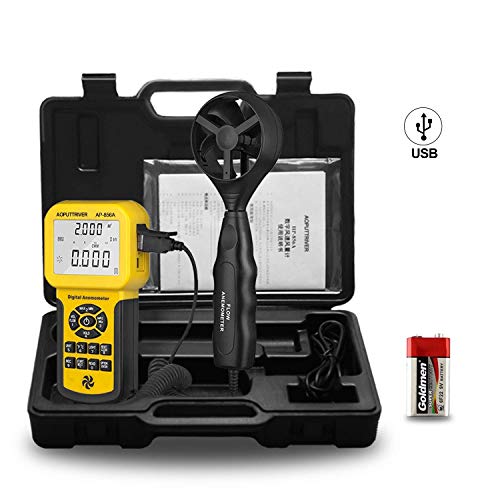
The AP-856A provides high-precision wind speed measurements from 0.001 to 100 mph and 0.001-45 m/s with +/- 3% accuracy. It captures wind temperature (32–113°F) and supports CFM readings by calculating flow with cross-sectional area input. Data can be exported via USB for PC analysis, and it supports MAX/MIN/AVG tracking. A large backlit display and durable design make it suitable for professional HVAC testing, windsurfing, sailing, and field work where data documentation matters.
AP-846A HVAC Anemometer
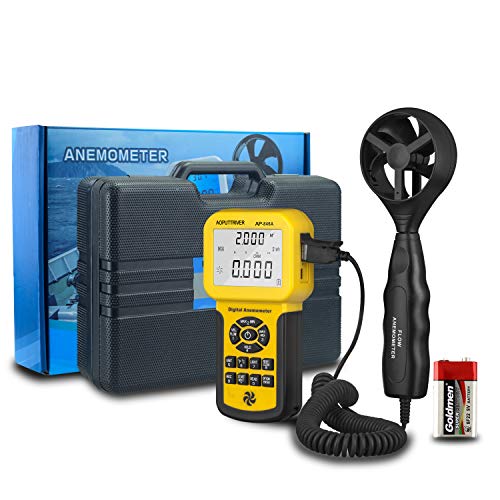
Like its sibling, the AP-846A offers high-precision wind speed in multiple units and a robust CFM measurement capability. It features a large, backlit display with MAX/MIN/AVG data modes, and a cross-functional design tailored for HVAC professionals. The device provides a wide measurement range for wind speed and temperature, with the ability to log and review recent measurements. Its durable form factor is suited for both field and shop environments where dependable wind and airflow data are essential.
HoldPeak 866B Bluetooth Anemometer

The HoldPeak 866B provides remote monitoring via Bluetooth and an accompanying app for real-time and historical data. It measures wind speed, wind chill, and temperature with dual temperature sensors and eight vanes for responsiveness. It supports multiple units (m/s, km/h, ft/min, knots, mph) and features MAX/MIN/AVG modes, a backlit display, data hold, and a long battery life. This model is well-suited for outdoor testing, sailing, aviation, and HVAC work requiring mobile data access and analysis.
Bonvoisin Hotwire Anemometer
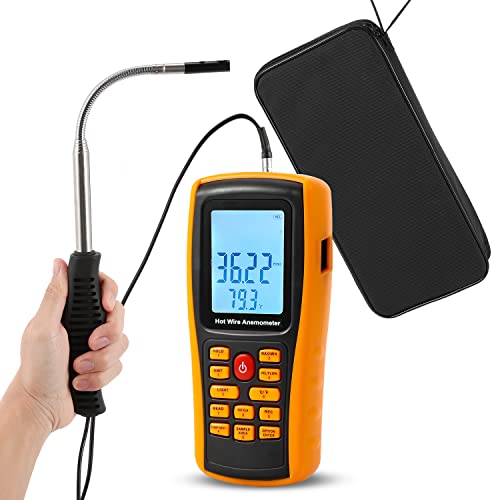
The Bonvoisin Hotwire Anemometer measures air velocity (m/s, km/h, ft/min, knots, mph), airflow (CFM/CMM), and temperature. It provides wind chill, max/min/average values, and offers a 2-meter-long probe with a bendable tip for flexible placement. The backlit LCD ensures readability in dim environments, and automatic power-off helps conserve battery life. This model is a practical option for HVAC duct work, field testing, and inspections where quick, clear readings are needed.
Buying Guide: Key Considerations For Choosing An Air Velocity Meter
- Measurement range and accuracy: Look for devices with wide speed ranges (e.g., 0.001–100 mph or 0.001–45 m/s) and clear stated accuracy. Smaller errors are crucial for precise HVAC balancing and airflow calculations.
- Units and display: Ensure the instrument supports multiple units (m/s, km/h, mph, ft/min, knots) and has a readable, backlit display. Temperature readouts (℃/℉) are often essential for environmental assessments.
- CFM/CMM calculations: If you need airflow volume, pick models that compute CFM or CMM from velocity and duct area. Some units require you to input cross-sectional area.
- Data logging and export: USB data export or Bluetooth/app connectivity helps in documenting measurements and performing trend analysis over time.
- Accessibility and ergonomics: Consider telescoping shafts or extendable probes for hard-to-reach ducts and outdoor settings. A lightweight, rugged design improves usability in-field.
- Power and battery life: Check battery indicators and auto-off features to avoid unexpected shutdowns during critical measurements.
- Calibration and certifications: Reputable brands with regular calibration support ensure long-term accuracy for professional workloads.
- Intended use cases: Outdoor shooting, drone operations, sailing, or HVAC service may require different sensor sensitivity, data formats, and mounting options.