For homeschoolers and curious young scientists, a well‑built chemistry lab kit can turn dry concepts into engaging experiments. The following selections focus on safety, hands‑on learning, and a wide range of experiments—from acids and bases to crystal growing and slime. Each kit includes kid‑friendly tools and clear instructions to support independent or guided study at home.
Summary of selected products:
| Product | Brand | Key Focus | Sample Activities |
|---|---|---|---|
| Thames & Kosmos Ooze Labs Chemistry Station | Thames & Kosmos | Colorful lab station with safe experiments | Slime, chromatography, bubbling reactions |
| National Geographic Mega Science Lab | Blue Marble | 130+ experiments across earth science and chemistry | Erupting volcano, crystals, fossils |
| Thames & Kosmos Chem C1000 Chemistry Set | Thames & Kosmos | Comprehensive lab with 125 experiments | Kitchen chemistry, professional tools |
| Discovery Super Reactions Science Kit | Discovery Kids | 66 guided and DIY experiments | Volcanoes, slime, reactions |
| Playz Extreme Chemistry Set | Playz | 52 experiments with lab gear | Foaming volcano, density stacks |
The following sections present five selected kits, highlighting what makes each one a strong fit for homeschooling, along with practical considerations to help families compare options and build a varied at‑home chemistry program.
Thames & Kosmos Ooze Labs Chemistry Station

The Ooze Labs Chemistry Station acts as a central workspace with colorful, kid‑friendly equipment. It supports experiments like glowing slime, fizzing reactions, oozing bubbles, and chromatography, offering a visually engaging entry into foundational chemistry ideas. With 57 pieces, the kit provides essential glassware and tools such as beakers, test tubes, and flasks, allowing students to simulate real lab procedures and observe reactions in a controlled environment. The emphasis is on safe, visually compelling activities that illustrate basic chemical concepts.
Potential strengths for a homeschool program include:
- Clear, hands‑on activities that reinforce observation and deductive reasoning.
- A broad range of experiments that span physical changes, color changes, and separation techniques.
- Engaging visuals that help maintain curiosity and motivation.
National Geographic Mega Science Lab

This Amazon Exclusive kit bundles earth science and chemistry into a big, immersive kit. It features more than 130 experiments, including a volcano eruption and glow‑in‑the‑dark crystal growth, plus real rock and mineral specimens for a tangible collection. The chemistry components enable bubbling reactions and simple gas demonstrations, making it a versatile choice for a longer‑term science curriculum. The expansive scope helps accommodate learners who want to explore multiple scientific domains beyond chemistry alone.
Considerations for use at home:
- Large scope supports weekly or monthly projects with built‑in variety.
- Includes a mix of guided experiments and open‑ended activities using household items.
- Potentially higher up‑front investment; best for families seeking breadth.
National Geographic Junior Chemistry Set

Geared toward younger learners, this kit provides a complete early‑learning lab experience with 50 hands‑on experiments. It emphasizes safety and simplicity, using common household items like baking soda and vinegar to demonstrate core chemical principles. Illustrated, easy‑to‑follow instructions guide beginners through step‑by‑step procedures, helping build confidence in conducting experiments independently while reinforcing basic measurement, sequencing, and observation skills.
Best use cases include:
- Introductory chemistry for ages 4 and up, with gentle progression.
- Family science time to practice following instructions and predicting outcomes.
- Strong foundational activities that prepare students for more complex kits later.
National Geographic Stunning Chemistry Set
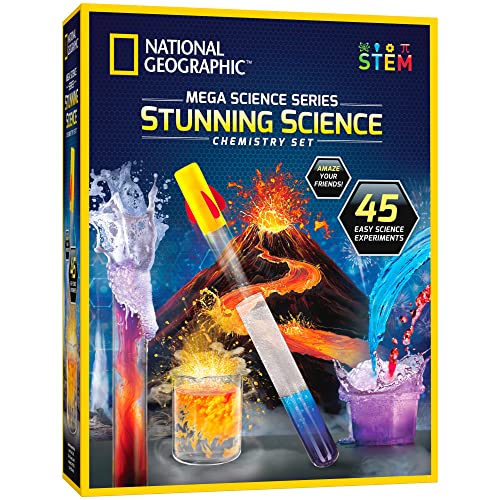
This mega kit emphasizes a lively, hands‑on approach to chemistry with 45 experiments designed to spark curiosity. Activities include building a volcano, creating geysers, and launching small rockets, all rooted in approachable explanations of chemical reactions. The user guide aims to be kid‑friendly, offering clear steps and illustrations to support independent exploration and a sense of scientific discovery. The kit’s breadth makes it suitable for a summer project series or a core year of chemistry study.
Key considerations:
- Balanced mix of classic experiments and engaging demonstrations.
- Accessible instructions suited for self‑guided learning with parental support as needed.
- Compact enough for smaller classrooms or shared家庭 study spaces.
National Geographic Amazing Chemistry Set

With over 100 experiments, this kit invites kids to perform color‑changing solutions, glowing test tubes, crystal growth, and more. The included materials support 15 core experiments and 85 bonus activities that can be carried out with household items, offering extended value for ongoing science projects. The emphasis is on visual effects and hands‑on manipulation, helping students observe how chemical reactions alter states, colors, and textures in tangible ways.
A few notes for use:
- Great for curious learners who enjoy trying many different experiments.
- Bonus activities provide long‑term engagement beyond the initial set.
- Clear, illustrated guidance helps prevent frustration and encourages independent work.
Thames & Kosmos Chem C1000 Chemistry Set

The Chem C1000 set positions itself as a more advanced, student‑level chemistry experience with professional‑quality equipment and a sizable experiment library. Students learn through hands‑on investigations into kitchen chemistry, exploring topics like sugars, proteins, fatty acids, and calcium derivatives, while maintaining a safe, structured laboratory environment. The included lab manual and quality instruments support a deeper dive into experimental design, measurement accuracy, and documentation practices.
Important aspects for homeschool planners include:
- A robust, professional feel that mirrors a real classroom lab.
- Potentially steeper learning curve; best for motivated middle school learners.
- Long‑term value from the comprehensive manual and a wide range of experiments.
Discovery Super Reactions Science Kit

Designed for ages 8 and up, this kit emphasizes 66 experiments, including 26 guided activities and 40 DIY ideas. It covers acid–base reactions, states of matter, pH indicators, and gas expansion through kid‑friendly experiments. The inclusion of volcano models, slime, and explosive‑themed demonstrations makes it appealing for ongoing experiments and themed weeks. The combination of guided and open‑ended activities supports a balance between structure and creativity in a homeschool setting.
Useful considerations:
- Structured guidance plus room for student creativity.
- Includes practical tools and materials to facilitate repeatable experiments.
- Suitable for extension projects if a student finishes core activities quickly.
Playz Extreme Chemistry Set

The Playz Extreme Chemistry Set features 52 experiments with a focus on visual effects and hands‑on discovery. Highlights include a foaming volcano, self‑inflating balloon experiments, and colorful test‑tube density stacks. The kit emphasizes real science through a kid‑friendly manual, reusable tools, and safe projects that promote independent learning and STEM skill development. It’s well suited for a family science day or a structured weekly lab routine within a homeschool plan.
How to approach this kit:
- Strong emphasis on practical, repeatable experiments.
- Clear, visual instructions that support self‑paced learning.
- Complementary with other kits to broaden topic coverage (e.g., chromatography or crystal growth).
Buying Guide: Key Purchase Considerations and Comparisons
When choosing a homeschool chemistry kit, families should weigh safety, scope, and instructional quality against cost and space needs.
- Safety and age suitability: Select kits with non‑hazardous materials for younger learners and more robust sets for older students. Look for clearly labeled age ranges and safety guidelines.
- Curriculum depth: For beginners, kits with guided experiments and illustrated instructions help build confidence. For advanced learners, sets with manuals, lab equipment, and a wide experiment library provide room to grow.
- Experiment breadth: Consider whether you want a kit focused on chemistry fundamentals or a broader science kit that blends earth science, physics, and chemistry for cross‑discipline study.
- Supplies and reuse: Reusable tools and durable materials extend the life of a kit. Check if consumables are included or require ongoing purchases.
- Parental involvement: Some kits are highly autonomous, while others are designed for guided discovery with parental facilitation. Align with your teaching style and available time.
- Progression planning: A varied collection allows you to rotate topics (e.g., slime weeks, volcano experiments, crystal growth) to maintain engagement and reinforce concepts over time.
- Storage and organization: Flat storage of tools and compartments helps keep materials organized, especially when multiple kits are used simultaneously.