For designers, engineers, and hobbyists seeking top-tier precision, choosing a 3D printer that delivers consistent, high-detail results is essential. This guide highlights five high-precision machines that excel in accuracy, reliability, and versatility across FDM and MSLA formats. Each option balances speed, bed leveling, enclosure or robust mechanics, and material handling to support complex projects with tight tolerances. Read on to compare features, build quality, and how each model suits different production or creative workflows.
Summary table of chosen products
| Product | Brand | Format | Key Precision/Capability Highlights |
|---|---|---|---|
| Bambu Lab P1S 3D Printer | BAMBULAB | FDM, Enclosed | Up to 16 colors/multi-material, 500 mm/s, auto bed leveling, enclosed for advanced filaments |
| MAGFORMS MateForm Air 4 | Magforms | MSLA Resin | 14.85 μm resolution, industrial-grade build, large 8.98 x 5.05 x 9.84 in volume |
| FLASHFORGE AD5X | FLASHFORGE | FDM, CoreXY | Up to 600 mm/s with 1-Click auto leveling, multi-color capability |
| 3D Printers TINA2 Plus V2 | Entina | FDM | 250 mm/s high-speed, auto leveling, WiFi, beginner-friendly |
| FLASHFORGE Adventurer 5M | FLASHFORGE | FDM, CoreXY | One-Click auto leveling, 600 mm/s travel speed, high-speed nozzle options |
Note: Each model has its niche in precision—MSLA printers typically offer the finest layer resolution, while advanced FDM machines focus on multidimensional accuracy, repeatability, and material stability. The list below prioritizes devices with strong calibration features, stable frames, and proven print quality for demanding projects.
Bambu Lab P1S: Enclosed, Multi-Material Mastery

The Bambu Lab P1S stands out with an enclosed chassis designed to stabilize printing conditions for advanced materials. Its ability to handle up to 16 colors or multiple materials expands creative options for prototypes and functional parts. A core-XY drive system and automatic bed leveling contribute to consistent first layers and reliable layer adhesion, which are critical for high-precision outcomes. The combination of fast performance and a controlled environment makes it suitable for engineering models and detailed enclosures, while the ready-to-use setup reduces downtime between prints.
Key capabilities include high-speed operation, strong acceleration, and an enclosure that minimizes warping on temperature-sensitive filaments. When used with compatible multi-material systems, it can streamline complex parts with precise color placement. For workplaces that require rapid iteration without sacrificing detail, the P1S offers a balanced blend of speed and accuracy.
FLASHFORGE AD5X Multi-Color Speedster

The FLASHFORGE AD5X is a high-speed CoreXY printer engineered for multi-color printing with strong precision. Its auto-leveling feature reduces human error in bed preparation, helping ensure reliable first-layer adhesion. The combination of 600 mm/s printing capability and 20,000 mm/s² acceleration supports rapid prototyping cycles without sacrificing print stability. The device is well-suited for teams that need to produce multiple iterations with color variation, enabling fast exploration of design options while maintaining dimensional fidelity in each color/mat layer.
Its streamlined architecture encourages repeatable results, and the 220 x 220 x 220 mm build volume is a practical size for small-to-midsize parts. For shops focusing on color-rich prototypes or functional models requiring tight tolerances, the AD5X provides a compelling mix of speed and precision with dependable automation features.
3D Printers Tina2 Plus V2: Fast, Ready-to-Use For Beginners
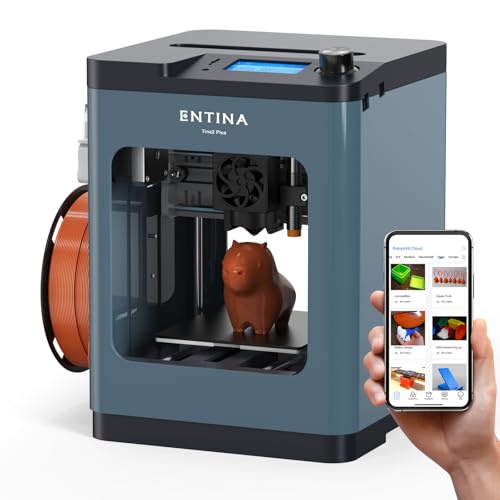
The Tina2 Plus V2 emphasizes speed and ease of use with a high 250 mm/s printing rate, enabling quick design validation. Its auto-leveling and WiFi connectivity simplify workflow setup, making it attractive for classrooms, hobbyists, and beginners who seek dependable, accurate prints without complex calibration. The compact footprint and ready-assembled design reduce the learning curve and enable straightforward operation for users prioritizing reliable results in a short time frame.
With the upgraded cooling and stable build, Tina2 Plus V2 can reliably reproduce fine features in standard PLA and PETG filaments. While it is more beginner-oriented, the printer’s high-speed capability supports mid-scale iteration cycles where precision is still a priority, especially in educational or prototyping contexts.
FLASHFORGE Adventurer 5M: Auto Leveling And Rapid Prototyping

The Adventurer 5M brings automatic bed leveling into a compact, all-metal CoreXY package designed for speed and reliability. A high-flow nozzle and fast warm-up to operating temperatures help maintain consistent extrusion characteristics across varied materials. The 3S detachable nozzle and streamlined hot-end arrangement support quick filament changes and reduced downtime, which enhances overall precision in rapid production scenarios. Dual-sided PEI platforms aid in easy part removal, contributing to repeatable print success and dimensional stability across multiple runs.
For users who require a balance of accuracy, speed, and minimal maintenance, the Adventurer 5M offers a straightforward path to high-precision parts, particularly in educational, small-lab, or design-for-manufacturing settings where schedule and reliability matter.
Buying Guide: Key Purchase Considerations And Comparisons
Choosing the best high-precision 3D printer depends on material needs, tolerance requirements, and workflow integration. Consider these factors when comparing models:
- Printer type and precision: MSLA resin printers deliver the finest layer detail (micron-scale) suitable for dental, jewelry, or highly-detailed miniature parts. FDM printers with rigid frames and advanced auto-leveling can also achieve excellent dimensional accuracy for functional prototypes.
- Enclosure and environmental control: Enclosures reduce warping and improve print reliability with temperature-sensitive materials. They also enhance safety when printing with some resins and powerful hot ends.
- Color and multi-material capabilities: For complex visual studies or assemblies that require multiple materials or colors, printers supporting multi-material workflows or resin multi-color printing can simplify design iteration.
- Print speed vs. accuracy: High-speed machines can accelerate development cycles, but ensure that acceleration and motion systems do not compromise layer consistency or roughness. Calibration and bed leveling features are crucial for repeatable results.
- Ease of use and maintenance: Auto-leveling, filament loading assistance, touchscreen controls, and straightforward software workflows reduce setup time and error rates, especially for teams with diverse experience levels.
- Build volume and feasibility: Assess whether your typical parts fit within the printer’s build area. Larger volumes enable multi-part prints but may require more robust calibration to keep tolerances consistent across a bigger surface.
- Materials and ecosystem: Confirm compatibility with your target filaments (PLA, PETG, ABS, or resin types) and whether you can source compatible cleaning, post-processing, and resin handling tools from the same ecosystem.
- Support and lifecycle: Strong vendor support, replacement parts availability, and software updates contribute to long-term precision and uptime, especially in professional environments.
In practice, the best choice depends on whether your priority is ultra-fine surface finish and small features (MSLA), or robust mechanical parts with color versatility and rapid iteration (high-end FDM with multi-material capability). For classrooms or makerspaces seeking immediate use, ready-to-run configurations with clear calibration procedures minimize learning curves while delivering reliable precision.
Regardless of the model chosen, a workflow that includes proper slicer settings, regular calibration, and routine maintenance will maximize precision and consistency across prints. When evaluating options, align the features with your production goals, material portfolio, and required tolerances to identify the printer that best fits your specific needs.