Explore top glass fiber and specialty filaments that improve strength, heat resistance, and finish for high-performance 3D prints. This guide highlights five standout options and helps you choose the right material for mechanical parts, outdoor use, and intricate engineering components. Each entry covers key advantages, printing considerations, and compatibility to support reliable, repeatable results on common FDM printers.
Summary of selected products (quick reference):
- SUNLU PLA Filament 1.75mm, Transparent PLA, 1 kg — excellent layer adhesion, neat winding, tight dimensional accuracy.
- SUNLU PA6-GF 3D Filament 1.75mm, 25% Glass Fiber Nylon, Gray — high-temp resistance and chemical durability.
- OVV3D Wood PLA Filament Bundle 4x200g, 1.75mm — real wood fiber, multiple wood tones, easy printability.
- ELEGOO Glass Fiber PETG Filament 1.75mm White, 0.5 kg — high stiffness, non-conductive, premium matte finish.
- Polymaker Fiberon PA6-GF Nylon Filament 1.75mm Gray, 0.5 kg — warp-free, strong with glass fiber reinforcement.
SUNLU Transparent PLA Filament — 1.75mm, 1 kg

The SUNLU PLA filament offers reliable performance with easy flow, minimal clogs, bubbles, or tangles. Designed for smooth layer adhesion, it is suitable for both beginners and experienced users seeking consistent results. The filament’s 1.75 mm diameter aligns with most FDM printers, and the packaging emphasizes a neat winding process to reduce tangling and jams during setup and continuous printing. DIMENSIONAL ACCURACY is specified at +/- 0.02 mm, contributing to precise, repeatable prints across standard build volumes.
Key features highlight a user-friendly experience: a neat winding spool that minimizes snags, dependable adhesion for clean surfaces, and broad compatibility with 1.75 mm printers. This option is particularly advantageous for projects requiring clear, transparent finishes where accuracy and clarity matter.
SUNLU PA6-GF 3D Filament 1.75mm — 25% Glass Fiber Nylon

This PA6-GF filament combines nylon’s toughness with 25% glass fiber reinforcement, delivering enhanced heat resistance and mechanical rigidity. The spool is designed for reuse and ease of drying before printing, with a maximum drying temperature up to 230°F (110°C). The filament maintains stability at elevated temperatures up to 401°F (205°C), supporting high-temperature parts and functional prototypes. Its chemical resistance and structural stiffness make it a strong candidate for engine components, housings, and environments where exposure to chemicals is a concern.
Printing considerations include ensuring proper drying prior to use to maximize mechanical properties and minimize warping. The glass fiber reinforcement contributes to dimensional stability, reducing deformation in challenging geometries and long prints. This filament is well-suited for functional parts that require strength and heat tolerance beyond standard nylon.
OVV3D Wood PLA Bundle — 1.75mm, Four Wood Types

The OVV3D Wood PLA bundle adds more than 30% real wood fiber to each 1.75 mm filament, delivering authentic wood aesthetics across Walnut, Oak, Cherry, and Teak tones. The 4 x 200 g spools offer variety for sculptural, decorative, or furniture-inspired prints that benefit from natural wood-inspired finishes. The filament is designed to minimize jams and tangles, with a diameter tolerance around +/- 0.03 mm to support stable extrusion and consistent layer formation. The base PLA plus wood fiber yields prints with texture and appearance resembling real wood, providing versatility for craft and practical projects alike.
Printing is generally straightforward for wood PLA filaments, though users should anticipate wood-like surface characteristics and potential differences in burnish and sheen compared to standard PLA. This option suits hobbyists seeking a warm, organic look for models, props, and small furniture accents, as well as educational demonstrations of wood-like materials without actual lumber.
ELEGOO Glass Fiber PETG Filament 1.75mm — 0.5 kg White

ELEGOO PETG-GF blends PETG with glass fibers to deliver higher stiffness and strength while maintaining the non-conductive properties essential for electrical housings and insulators. The resulting prints exhibit a premium matte finish, with reduced visible layer lines thanks to the glass fiber reinforcement. This filament is recommended for parts demanding rigidity, impact resistance, and a clean surface finish, all while remaining easier to print than some high-temperature engineering plastics.
Considerations include higher printing temperatures compared to standard PETG and careful bed adhesion strategies. The non-conductive nature makes it attractive for components in electronics enclosures and protective casings, where electrical insulation is advantageous and surface aesthetics matter.
Polymaker Fiberon PA6-GF Nylon Filament 1.75mm — 0.5 kg Gray
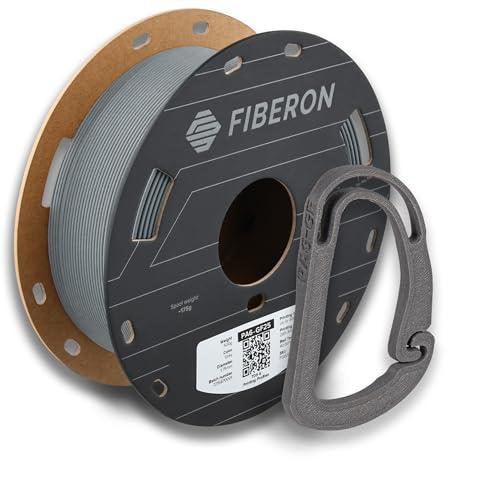
Polymaker’s Fiberon PA6-GF nylon filament combines nylon’s intrinsic toughness with glass fiber reinforcement for improved stiffness and dimensional stability. Described as warp-free and optimized for high-speed printing, Fiberon PA6-GF supports parts requiring torsional, tensile, and impact strength. The 1.75 mm diameter is compatible with a wide range of mainstream printers, enabling reliable extrusion and consistent layer adhesion. Its glass fiber reinforcement helps maintain form under load, making it suitable for brackets, jigs, drone frames, and other demanding components.
When printing, users should optimize print temperatures and speeds to maximize strength while preventing delamination. The material’s performance makes it a strong candidate for mechanical prototypes and end-use parts where durability and resilience are essential, particularly in automotive or industrial contexts.
Siraya Tech Fibreheart ABS-GF Glass Fiber Filament — 1 kg, Black

Siraya Tech ABS-GF combines the durability of ABS with glass fiber reinforcement, offering enhanced toughness, impact resistance, and dimensional stability. The filament exhibits an HDT of 93°C, enabling robust performance in higher-temperature environments beyond standard ABS. Precision printing is supported by the fiberglass reinforcement, which reduces warping and maintains shape integrity across complex geometries. This makes ABS-GF a strong choice for automotive and industrial parts that demand long-term stability under use and heat.
Printing considerations include ABS-style post-processing and odor management typical of ABS derivatives. The glass-fiber reinforcement helps improve rigidity and load-bearing capacity, while maintaining reliable extrusion. It is well-suited for functional components, housings, brackets, and performance parts that must withstand heat and impact.
Creality 3D Printer Filament 1.75mm — Rainbow PLA+

The Creality Rainbow PLA+ filament improves toughness and print quality over standard PLA, offering higher resistance to breakage and strong, flexible results. The No-Clogging and No-Bubbling patent design supports smooth extrusion and increased printing success rates, with consistent surface finishes across the color spectrum. The 1 kg spool at 1.75 mm diameter maintains a tight tolerance of +/- 0.02 mm, supporting accurate prints on most 1.75 mm FDM printers. Multi-color capability expands design possibilities for models, figurines, and decorative items.
Printing considerations include maintaining stable temperature and proper cooling to maximize color fidelity and surface smoothness. PLA+ generally prints at moderate temperatures with easier post-processing compared to ABS, making it a practical option for everyday projects requiring color variety and reliable results.
iSANMATE ASA-GF Glass Fiber Filament — 1 kg, Grey

iSANMATE ASA-GF combines ASA resin with glass fiber reinforcement to deliver excellent UV and weather resistance, ideal for outdoor and high-impact applications. The filament is designed for compatibility with most consumer and industrial 3D printers, offering reliable performance while withstanding long-term exposure to sunlight and harsh environments. Printing requires attention to printer enclosure and bed adhesion, with recommended settings within typical ASA ranges. This option suits projects exposed to sunlight or outdoor conditions, such as architectural models, housings, and protective components where weather resistance is critical.
The 1 kg spool provides consistent diameter control, supporting predictable extrusion and surface finish. The glass fiber reinforcement adds stiffness for better dimensional stability under load, contributing to more accurate and robust outdoor parts.
Buying Guide: Glass Fiber And Specialty Filaments
- Purpose and environment: Choose materials with properties matched to your application—heat resistance, UV stability, chemical resistance, or outdoor durability. ABS-GF and PA6-GF variants excel in high-stress, temperature-rich settings, while PETG-GF offers a balance of stiffness and impact resistance for housings and mechanical parts.
- Printer compatibility: Confirm nozzle and bed temperatures, enclosure needs, and whether your printer can handle reinforced filaments (some printers require higher temperature capabilities or enclosed chambers).
- Printing parameters: Expect adjustments in extrusion temperatures, cooling, and print speeds. Some GF filaments benefit from slower speeds to reduce warping and improve layer adhesion.
- Post-processing: Glass fiber and wood-filled filaments may finish differently from standard polymers. Sanding, sealing, and coating choices can influence final strength and appearance.
- Diameter tolerance and winding: Filaments with tighter tolerances (+/- 0.02 mm) generally yield more consistent extrusion. Neatly wound spools reduce tangling and jams during long prints.
- Finish and aesthetics: For visible parts, consider matte finishes (PETG-GF, ABS-GF) or wood-toned textures (wood PLA) to achieve the desired look without extensive post-processing.
When selecting a filament, compare the specific reinforcement (glass fiber content), base polymer (PLA, PETG, Nylon, ABS), and intended application. High-performance filaments provide strength and stability for functional parts, but may require printer upgrades or adjustments to achieve optimal results. By aligning material properties with the part’s demands, you can maximize print quality, durability, and lifespan of the final product.