For educators, students, and medical professionals, an accurate brain model is an essential tool. This guide highlights five high-quality brain models that faithfully reproduce major brain structures, lobes, and vascular features. Each option offers clear labeling, life-size scaling, and durable materials to support patient education, classroom demonstrations, and self-guided study. Below, you’ll find succinct product details and practical buying considerations to help you compare features like color coding, part count, and anatomical accuracy.
Summary Table Of Chosen Products
| Product | Brand | Key Features | Parts | Link |
|---|---|---|---|---|
| QWORK Skull And Brain Anatomy Model | QWORK | Life-size, 11 parts, labeled numeric markers | 11 | View |
| Cross Section Foam Brain Model | Merhoff & Larkin | Two half-pieces, labeled figures, included worksheets | 2 halves | View |
| WICHEMI Brain Model Eight Parts | WICHEMI | Color-coded sections, display base | 9 components | View |
| ZENFUN Life-Size Brain Model | ZENFUN | Color-coded partitions, 1:1 scale | 2 parts | View |
| Axis Scientific 3-Part Skull With Brain | Axis Scientific | Anatomically accurate skull and brain, magnetic features | 8 parts (brain/ Skull combos) | View |
The following sections review these models in more detail, focusing on what makes each one stand out for anatomy study, patient education, and classroom use. Each product description is concise and evidence-based to support objective comparisons.
QWORK Skull And Brain Anatomy Model

The QWORK model provides a life-size representation of both the skull and brain, with a total of 11 parts split between the skull and brain sections. The brain portion includes a sagittal section, cerebral hemisphere, cerebellum, and brainstem, enabling a clear view of core brain anatomy. A labeled diagram identifies 32 numeric brain markers, while the skull side carries 55 numeric markers. This arrangement supports detailed study of surface features, internal brain structures, and their relationship to cranial anatomy, making it suitable for medical education and patient explanations alike.
Cross Section Foam Brain Model

This foam brain model emphasizes practicality for teaching and group activities. It features two half-brain pieces, each labeled with key anatomical areas, including the amygdala and hippocampus in the labeled diagrams. The model arrives with an answer sheet and a digital worksheet, facilitating guided teaching sessions and self-directed study. Its size mirrors natural dimensions to support realistic demonstrations, and the stand-ready design makes it easy to incorporate into classroom displays, clinics, or therapy sessions without requiring advanced setup.
WICHEMI Brain Model Eight Parts

The WICHEMI model offers a nine-component construction that includes sagittal brain sections, cerebral hemispheres, cerebellum, brainstem, diencephalon, and cranial nerves. Made from PVC, the model is lightweight yet sturdy and designed for repeated classroom use. Its color-coded sections help learners distinguish anatomical regions quickly, supporting both introductory neuroscience courses and more advanced anatomy labs. The inclusão of a display base helps educators present the model in a stable, accessible manner during demonstrations or exams.
ZENFUN Life-Size Brain Model

The ZENFUN model stands out with its color-coded partitions that clearly identify major regions such as the frontal, parietal, occipital, and temporal lobes, plus motor cortex and other critical structures. With a two-piece design, it provides a 1:1 life-size representation that is easy to display in classrooms or patient education sessions. Constructed from PVC, the model emphasizes durability and longevity in busy teaching settings, and the base adds stability for tabletop displays and presentations.
Axis Scientific 3-Part Skull With Brain

Axis Scientific emphasizes anatomical accuracy and professional-grade detail. This model blends a three-part skull with a removable brain, enabling focused study of cranial anatomy and brain morphology. It is marketed as a reliable option designed by anatomy professionals, with emphasis on avoiding common inaccuracies found in cheaper imports. The model is intended for neuroscience study and classroom demonstrations, and Axis Scientific collaborates with medical professionals to ensure quality and realism in the replica, including a magnetic feature for interactive learning.
QWORK Life-Size Brain Model

The QWORK life-size brain model focuses on a color-coded partition approach to highlight major brain regions on a lifelike scale. It features a two-part design with a base, allowing educators to present clear views of the frontal, parietal, temporal, and occipital areas, along with key cortical areas. Built from PVC, it emphasizes durability and ease of handling for repeated demonstrations and patient education sessions. The model’s size aligns with standard classroom displays, enabling effective size-perception for learners.
Human Skull With Brain And Cervical Vertebra
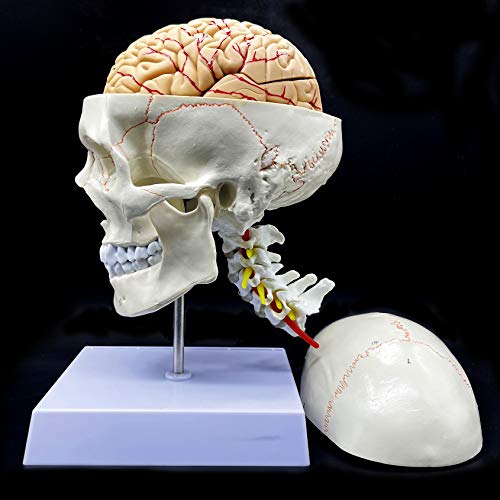
This life-size model pairs the skull with brain and cervical vertebra, providing a holistic view of cranial and upper spinal anatomy. It is designed for patient education and anatomical study, detailing the major structures of the skull, brain, and upper vertebral column. The PVC material ensures durability, while the labeled diagram for numeric markers supports structured learning and quick reference during lectures or exams.
QSMYS Skull And Brain With Cervical Vertebra
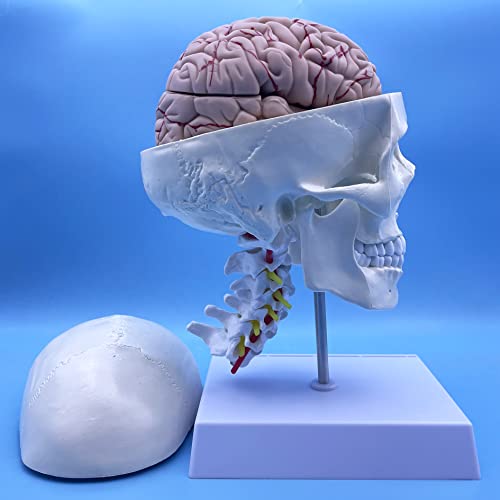
The QSMYS model focuses on a life-size representation of the human skull and brain along with cervical vertebrae, designed for classroom study and patient education. The PVC construction provides durability, and the arrangement aims to clearly depict all major anatomical structures of the skull, brain, and cervical spine. This model is positioned as a practical teaching tool for anatomy students and healthcare professionals seeking a clear, accessible reference.
Buying Guide: Brain Model Purchase Considerations
When choosing a brain model, consider the following:
- Level of detail: Do you need just the brain, or the skull with cervical vertebrae for broader anatomy studies?
- Number of parts: More components allow deeper exploration of divisions like lobes, stem structures, and nuclei, but may be heavier or pricier.
- Color coding and labeling: Color-coded regions and numeric markers help learners identify structures quickly and reduce misinterpretation.
- Material and durability: PVC and foam offer different balances of weight, durability, and realism. Foam models are easy to handle for younger students, while PVC models suit professional settings.
- Size and base: Life-size models are most effective for realism, but bases improve stability on desks and display boards.
- Educational resources: Included worksheets, answer keys, or digital supplements can enhance lesson planning and assessment.
- Maintenance and replacement parts: Check whether components are easy to replace or repair if damaged during demonstrations.
Preserve accuracy by comparing models that originated from professional anatomy guidance or medical-grade production. For classrooms, balance detail with durability and cost. For clinics and patient education, prioritize clarity and labeling that supports understanding of complex regions and functions.